'%20clip-path='url(%23canvas-clip)'/%3e%3cg%20clip-path='url(%23canvas-clip)'%3e%3cg%20transform='rotate(0,%20256,%20256)'%3e%3cg%20transform='translate(87%2087)%20scale(14.083333333333334%2014.083333333333334)%20translate(0%200)'%3e%3cpath%20fill='none'%20stroke='%23FFFFFF'%20stroke-linecap='round'%20stroke-linejoin='round'%20stroke-width='2'%20d='m18.064%2010.877l-4.89-7.26c-.42-.625-1.287-.803-1.936-.397a1.4%201.4%200%200%200-.41.397l-4.893%207.26C4.24%2013.715%204.9%2017.318%207.502%2019.423a7.13%207.13%200%200%200%204.168%201.572M15%2018a3%203%200%201%200%206%200a3%203%200%201%200-6%200m5.2%202.2L22%2022'/%3e%3c/g%3e%3c/g%3e%3c/g%3e%3c/svg%3e)
Agent-Ready Ecommerce: What Cloudflare Wallets Means for Agentic Commerce, Payments, and Search
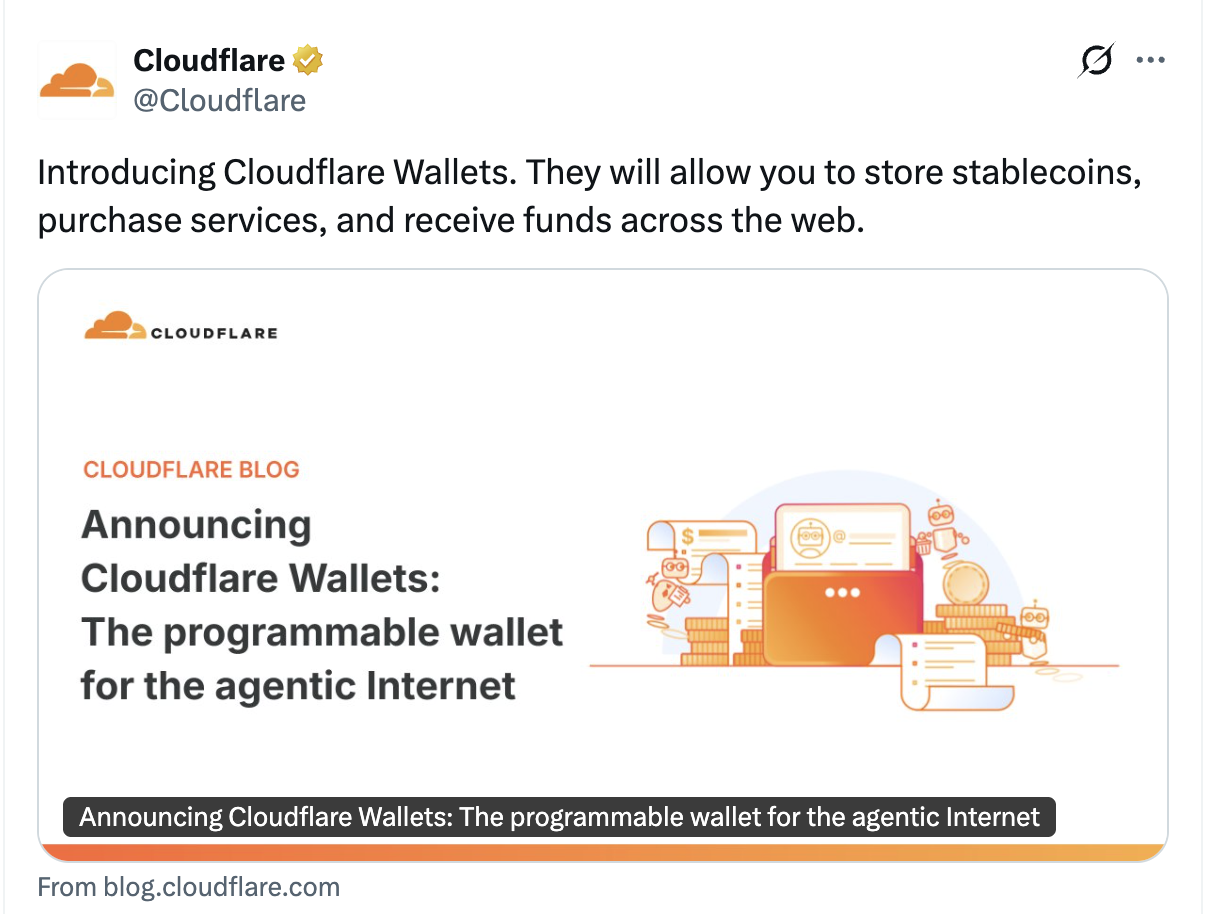
Cloudflare announced Wallets on August 4, 2026.
Handle claiming is live today; native payment and agent spending are still roadmap.
It is, in our view, the clearest signal yet that agentic commerce is shifting from demo to infrastructure.
Our read: the wallet and payment layer is necessary but not sufficient. The harder, less-discussed problem is the answer layer. A browser-driven agent can navigate a rendered page through the DOM or visual interaction, but that path must infer state and repeat a human workflow. Structured, attributable, bounded answers make product identity, price, availability, and recovery easier to verify and govern.
This guide gives our opinion on what the launch means for payments, crypto, ecommerce, and for a search and discovery business like ours. It introduces the Agent Search Contract, the structured answer a machine buyer needs, and a readiness checklist you can run today.
The shopper is becoming a piece of software. When that shopper is an agent, your search layer stops being a user interface and becomes a machine-to-machine contract. Build the contract before the traffic arrives.
Chapter 1 · What Cloudflare actually shipped
A wallet for agents, with payment and identity attached
Cloudflare’s Wallets announcement rests on three ideas. First, every account gets a human-readable handle at cloudflare.pay, and that is live today. Second, an account can delegate spend to Virtual Wallets that agents control within set caps, but that part is still roadmap. Third, it pairs with x402, a protocol that attaches stablecoin micropayments to ordinary HTTP requests. x402 is an open specification from the x402 Foundation, not a Cloudflare-only format, so any seller or wallet that implements it can interoperate. The mechanism is concrete: a server answers a request with HTTP 402 "Payment Required", the agent pays in stablecoins with no signup or API key, and access is granted. The network is already busy: the x402 Foundation reported roughly 75 million transactions and 24 million US dollars in volume across about 94,000 buyers and 22,000 sellers in the 30 days before this analysis.
The launch targets the two frictions that stop agents from buying today: identity and payment. Without a stable account, an agent cannot be attributed or trusted. Without a native way to pay, it needs a human to add a card, generate a key, and read documentation it cannot finish alone. The commercial question is therefore narrower than whether agents can operate a browser: can a merchant attribute the buyer, bound what it may spend, and verify the product state that justified the action?
We want to be straight about one thing. The announcement describes most wallet spend and x402 payment behaviours as coming soon. We treat the identity handle as live and the spend, payment, and broad API-access flows as roadmap. Beyond handle claiming, nothing here should be read as live, universally available infrastructure. One seller-side boundary: Cloudflare's Monetization Gateway, which lets sellers get paid headlessly, is limited to eligible Cloudflare customers and x402-compatible endpoints, so an agent can only complete a purchase where the seller has adopted that stack.
| Claim | Status | What it means |
|---|---|---|
| Cloudflare Wallets gives each account a human-readable handle at cloudflare.pay. | Live | Available today: you can claim a handle that delegates a stable identity to agents, so merchants can tell who is buying. |
| Account Wallets hold funds; Virtual Wallets let agents spend within caps you set. | Roadmap | Spending limits, allow lists, and maximum transaction size are described as the guardrail model. |
| x402 attaches stablecoin micropayments to HTTP requests for API and content access. | Announced | Monetization Gateway is the seller side; a wallet is the buyer side. Both are described as coming soon for general use. |
| Agents can explore many APIs with low friction once funded. | Roadmap | The pitch is that a few cents per try and a small cap beat a human-in-the-loop sign-up flow. |
Chapter 2 · The gap that still exists
Identity and payment are solved first. The answer layer is not.
Cloudflare is building the buyer side of agentic commerce: who is the agent, and how does it pay. That is real progress. But a funded, identified agent still arrives at a store that was built for a human with a screen.
If the store only returns a rendered results page, a browser-driven agent can still inspect the DOM or use visual interaction. The trade-off is that product identity, selected variant, price, availability, and match confidence may need to be inferred from a changing interface. A structured, truthful, bounded response reduces that inference. We call this the answer layer, and it is where search and discovery work lives.
No stable identity
An agent arrives at a site with no reliable account, so merchants cannot attribute, entitle, or trust it.
No native way to pay
Onboarding needs a human to add a card, generate a key, and read docs an agent cannot complete alone.
No answer layer
Even with identity and payment, many stores we see built for a human UI still only emit a rendered page. A browser-driven agent may infer that page; structured fields make the answer more reliable and auditable.
Chapter 3 · The core thesis
When the shopper is an agent, search becomes an interface between machines
A human shopper and a machine shopper have the same jobs. They want the exact variant, the attribute-constrained set, the compatible part, or the comparison shortlist. The difference is what they consume. A person reads a card. An agent needs the record behind the card, with enough structure to act.
This is not a new problem dressed up. It is the same query-understanding and catalogue-structure work search teams already do for people, now exposed as a contract rather than a page. The merchant who treats agentic commerce as "add a wallet" will miss it. The merchant who treats it as "make our answers machine-readable" is already building the right thing.
Our opinion: identity and payments are getting solved by platforms. The durable, defensible work for a store is the answer layer. That is also where a search and discovery product earns its place.
A store is agent-ready only when a machine can complete a job, not just open a page. Rendering a beautiful results page to a bot that cannot parse it is the 2026 equivalent of a phone-only support line for a customer who emailed.
Chapter 4 · The Agent Search Contract
The answer a machine needs is the human response contract, made explicit
Our existing search intent and architecture guides already describe a response contract for people: query, match state, result records, count, facets, sort, and continuation. The Agent Search Contract is that same contract, stated so a machine can branch on it, plus one new field the wallet era requires: authorisation.
Each field has a human meaning and an agent meaning. The agent meaning is what lets software decide, recover, and stay within bounds without a human in the loop.
| Field | Human meaning | Agent meaning |
|---|---|---|
| Query | The words and options the shopper typed. | A normalised request with explicit identifier, attributes, and constraints. |
| Match state | Whether these are exact, partial, corrected, or no-match results. | A machine-readable status so the agent can branch instead of guessing. |
| Result records | Products with the right image, price, and variant. | Records that carry variant identity and matched evidence, not just titles. |
| Count and facets | How many results and which filters are available. | Exact totals or honest estimates, plus valid refinement values. |
| Continuation | Load more or page through stable results. | A cursor or offset that preserves order and position. |
| Agent authorisation | Not applicable to a person. | The wallet handle and spend scope that make the request attributable and bounded. |
This is a framework, not a wire format. The deeper treatment lives in the Agent Search Contract guide, and the catalogue foundation in the agent-readable catalogue guide.
Chapter 5 · What it means, in our view
Our opinions on payments, crypto, ecommerce, and the discovery business
These are analyst opinions, not product claims. We state them plainly and mark the boundary of what we can defend.
Payments
Stablecoin micropayments via x402 are the plumbing, not the point. The point is removing the human from the payment step so a machine can buy a cent of API access.
Boundary: This is announced infrastructure. Treat every wallet and x402 capability as roadmap until you can test it on your own store.
Crypto
The crypto-relevant shift is narrow: a stablecoin settlement rail for tiny, frequent machine payments. It is a payments-efficiency story, not a new monetary philosophy.
Boundary: Do not read this as a broad crypto adoption thesis. The claim is specific to x402 and stablecoins as described by Cloudflare.
Ecommerce
Discovery becomes the storefront. A browser-driven agent can inspect a rendered page, but a structured answer reduces inference and preserves identity, price, and match state. The catalogue should become answerable, not just browsable.
Boundary: Many stores are not there yet. The work is catalogue and search quality, which merchants should do regardless of agents.
Search and discovery businesses
A search platform is no longer only ranking products for people. It is the layer that decides whether a machine can understand and act on a store at all.
Boundary: This is our read of the direction, grounded in how query understanding and catalogue structure already work today.
Chapter 6 · Payments and crypto, specifically
Stablecoin micropayments are a plumbing upgrade, not a philosophy
The wallet announcement leans on stablecoins because x402 settles tiny payments over HTTP without a checkout. For an agent that wants to try an API for two cents, that removes the human from the loop. That is genuinely useful.
But we would not over-read the crypto angle. The mechanism is a settlement rail for small, frequent, machine-initiated payments. It is an efficiency story about removing card-on-file and manual invoicing from agent flows. It is not, on the evidence in the announcement, a broader statement about monetary policy or token adoption.
The more durable shift is identity. A handle at cloudflare.pay that delegates to agents solves the attribution problem that plain bots never could. A merchant can finally tell whether a buying agent represents a known organisation. That changes trust, entitlement, and abuse control far more than the settlement token does.
Chapter 7 · What it means for ParticleSearch
A search platform becomes the layer a machine judges a store by
For a search and discovery company, agentic commerce is a forcing function, not a new product category. The work an agent needs, query understanding, variant precision, structured results, honest match states, is the same work a good search platform already does for people. Agentic commerce just makes that work observable to software.
We are not announcing an agent API here. We are stating the direction: stores that invest in catalogue quality and a real response contract will be easier for a machine to shop reliably. Stores that only render pages ask browser-driven agents to infer more state from the interface, however good the page looks to a person.
The honest position is that ParticleSearch helps a merchant prepare the answer layer. It does not replace the wallet, the payment rail, or the agent. It makes the store's response something an agent can trust and act on, which is the part no payment innovation solves on its own.
Chapter 8 · Merchant readiness checklist
Four steps you can take before agent traffic arrives
You do not need a wallet to start. The preparation is catalogue and search work you should do anyway. Each step below links to the deeper guide.
Step 1
Name the agent jobs your catalogue must serve
Exact identifier, attribute request, compatibility, and comparison queries matter most to a machine buyer.
Read the search intent guideStep 2
Make the response contract explicit
Decide which fields an agent receives: match state, variant identity, count, facets, continuation.
Read the Agent Search ContractStep 3
Repair the catalogue foundations
Stable identity, variant precision, and governed attributes are what make any answer truthful.
Read the agent-readable catalogue guideStep 4
Validate end to end
Run one identifier, one attribute, one compatibility query and confirm the result proves the job.
Read the architecture guideChapter 9 · What this looks like in practice
Agentic commerce, in plain language, with the page a person sees
The phrase "agentic commerce" hides a simple idea: a program, not a person, is doing the shopping. The difference is not science fiction. It is the same store, two very different shoppers. Below are three everyday scenarios. In each, we show what a person does, what an agent does, and where it breaks today.
Scenario 1 · The repeat buyer
"Reorder the navy trail shoe in UK 8 wide"
Person: remembers the brand, opens the product, picks the colour and size, adds to cart.
Agent: sends one identifier, TR4-NV-08-W, and expects the exact variant
back with price and a handoff that opens on that variant.
Where it breaks today: search returns the product family and asks the agent to choose every option again, so the handoff loses the work.
Scenario 2 · The fitment search
"Cabin filter for a 2019 Honda Civic"
Person: reads "fits Civic 2016 to 2021", decides it applies, adds it.
Agent: needs a compatibility fact, not similar
wording. It must see fitment: 2019 Civic (confirmed) or it should name
the missing dimension.
Where it breaks today: compatibility lives in the description, so the agent cannot treat it as a constraint and may pick a visually similar but wrong part.
Scenario 3 · The comparison shopper
"Standing desk under £800, oak top"
Person: scans cards, compares prices and finishes, picks one.
Agent: needs the price basis, currency, and the "oak" attribute as fields it can filter on, and a count it can trust.
Where it breaks today: "oak" is prose in the title, so the agent cannot enforce it and returns walnut too.
Notice the pattern. In every case the agent's job is the same as the person's. The only difference is what each consumes: a person reads a page and infers; an agent needs the fact stated as data. The store that wins is the one whose answer is a contract, not a picture.
This is also why the Cloudflare launch matters but does not finish the job. A funded, identified agent still arrives at a store built for a human with a screen. The wallet gets it through the door. The answer layer is what lets it actually buy.
Research basis · Where this analysis comes from
Opinions are labelled; facts are sourced
The launch facts in this guide come from Cloudflare's own announcement and the x402 and Monetization Gateway references. The framework builds on our existing search intent and architecture material. Platform capability claims about native storefront search use Shopify's developer documentation.
Where we express a view about the future of payments, crypto, or the discovery business, we have marked it as opinion and stated its boundary. We have not presented roadmap features as live infrastructure.
Sources checked August 4, 2026
- Cloudflare, "Wallets": The launch announcement this analysis responds to, published August 4, 2026.
- Cloudflare, "Monetization Gateway": The seller-side context for x402 micropayments.
- x402 protocol: The open, neutral payment standard (x402 Foundation) for HTTP-native stablecoin micropayments; source of the network-volume figures cited.
- Shopify Storefront API search: Reference for native storefront search. A typical search result is built for a human reader; confirm the exact fields your store returns before relying on any gap.
Where ParticleSearch fits
We help a store become answerable, not autonomous
ParticleSearch does not issue wallets, settle payments, or act as an agent. Its job is the answer layer: turning a query into a structured, truthful, variant-precise result that a person or a machine can both use. As agentic commerce arrives, that layer is what decides whether a store is shoppable by software at all.
The merchant still owns the catalogue, the configuration, and the storefront. The operational relief is a shared contract for what a good answer looks like, so the same search quality work serves human and agent shoppers without a second system.
Judgement: For most Shopify merchants, investing in catalogue quality and a machine-readable response contract is the most effective way to prepare for agentic commerce.
Reader-run acceptance test: Verify that your store's search returns variant-precise results with honest match state for a SKU-level query. See the agent-readable catalogue guide for how to check.