'%20clip-path='url(%23canvas-clip)'/%3e%3cg%20clip-path='url(%23canvas-clip)'%3e%3cg%20transform='rotate(0,%20256,%20256)'%3e%3cg%20transform='translate(87%2087)%20scale(14.083333333333334%2014.083333333333334)%20translate(0%200)'%3e%3cpath%20fill='none'%20stroke='%23FFFFFF'%20stroke-linecap='round'%20stroke-linejoin='round'%20stroke-width='2'%20d='m18.064%2010.877l-4.89-7.26c-.42-.625-1.287-.803-1.936-.397a1.4%201.4%200%200%200-.41.397l-4.893%207.26C4.24%2013.715%204.9%2017.318%207.502%2019.423a7.13%207.13%200%200%200%204.168%201.572M15%2018a3%203%200%201%200%206%200a3%203%200%201%200-6%200m5.2%202.2L22%2022'/%3e%3c/g%3e%3c/g%3e%3c/g%3e%3c/svg%3e)
Change one search behaviour without guessing at the rest.
Query tools, ranking, synonyms, redirects, merchandising, and experiments give your team focused ways to improve discovery while keeping the change reviewable.
The control path
Choose a control that matches the symptom.
A synonym is not a redirect. A ranking change is not a product-data repair. The path stays clear when the intervention matches the evidence.
Observe
Symptom
Choose
Control
Preview
Compare
Publish
Scope
Verify
Learn
The merchant answer
The safest search change is usually the smallest one that fixes the observed problem. ParticleSearch lets a merchant inspect a query, choose the right intervention, preview the outcome, publish it, and keep the change easy to revisit.
A look inside ParticleSearch
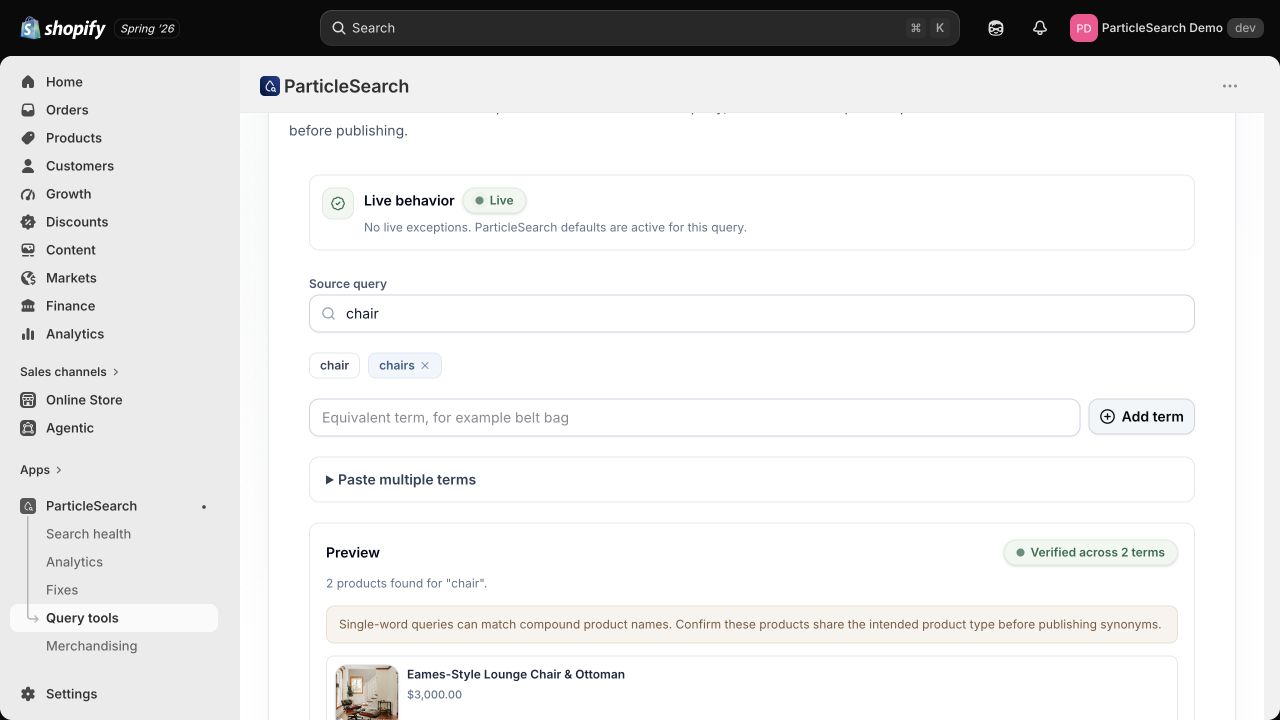
Review a search change before it reaches shoppers.
Example merchant workflow for checking a synonym group against product results before publishing.
Guides and field notes
Go deeper when the decision needs detail.
Use these practical guides for the context, merchant decisions, and acceptance tests behind the capability you are evaluating.
The path
Keep the intervention smaller than the problem.
A focused control is easier to preview, explain, and reverse when the evidence only points to one query, collection, or audience.
Inspect one query
Start with the shopper phrase, returned products, evidence, and the surface where the behaviour breaks.
Choose the right intervention
Use a synonym for a true substitute, a redirect for clear navigation intent, ranking for product order, or merchandising for a campaign or collection goal.
Preview, publish, and learn
Compare the expected result, publish with a clear scope, and use history, diagnostics, or experiments to decide what to keep.
Decision guide
Questions this capability should answer
Use these questions to decide whether this capability is the right next move for your store.
Which control fits the observed symptom?
Use synonyms for true substitutes, redirects for navigation intent, ranking for product order, and merchandising for a commercial context.
How much scope does the change need?
Prefer one query, collection, audience, market, or experiment when the evidence does not justify a broader change.
What should be checked before publish?
Compare the intended result, protect important queries, and make sure the active change is easy to explain and revisit.
What is included
A toolkit for precise, explainable changes
Different symptoms need different controls. The dashboard keeps them together without pretending that a ranking boost can repair missing product data.
Query tools
Inspect a query and its result evidence before choosing an intervention. Start from the symptom, not from a favourite setting.
Ranking and merchandising
Change product order for a focused query, collection, campaign, audience, or market when the business context calls for it.
Synonyms for true substitutes
Connect terms shoppers use interchangeably, with a review step before the group affects live search.
Redirects for navigation intent
Send a known phrase to one useful destination when the shopper is looking for a collection, page, or other intentional route.
Experiments and protected queries
Test search or recommendation changes with controlled variants, and protect important queries with repeatable checks before a broader rollout.
Verified publishing
Keep publishing blocked while a draft is changing or unverified, then use runtime health, configuration sync, golden queries, and history to confirm what is live.
Publish history and diagnostics
Keep published changes reviewable, edit or pause live rules, find conflicts or stale rules, and make it easier to understand what is active.
A useful boundary
Good product decisions include what the feature cannot solve.
ParticleSearch gives your team more evidence and control. It does not remove the need for accurate product data, a clear merchandising goal, or a review of the result on your own store.
- A rule is not a substitute for clean titles, identifiers, variants, availability, or useful product attributes.
- Synonyms should describe genuine equivalence. A broad related term can create false positives and should be tested as a different problem.
- Experiments and protected queries support safer decisions, but the merchant still chooses the scope, audience, and success question.
Keep exploring
See how this fits with the rest of the product.
See it on your store
Give your team a clearer way to improve search.
Install through Shopify, enable the app embed in your published theme, and run one proof check on your own storefront. Eligible Shopify installs · Shopify confirms trial eligibility before approval. Billing remains handled through Shopify.