 ParticleSearch
Useful search knowledge, organized around the decision in front of you.
These are evergreen guides for merchants, operators, founders, and teams responsible for product discovery. Start with the symptom, understand the mechanism, and leave with a testable next move.
Choose a reading path
Start with the job, not the format.
Every card points to the same canonical article routes used by blog search, related reads, and feature pages.
Start with the problem
Find the guide closest to the failure.
Begin with the shopper symptom, then follow the evidence to the smallest repair that can change the outcome.
Search Diagnostics
Shopify Search Not Working? A Surface-by-Surface Diagnostic Guide
Trace one broken-search report from symptom to layer, evidence, owner, and acceptance test across Shopify predictive search, full results, filters, and variant handoff.
Product Recommendations
Shopify Product Recommendations Not Working: Diagnose Missing, Empty, or Wrong Results
Diagnose Shopify product recommendations that are missing, empty, or wrong by separating theme delivery, API responses, candidate eligibility, recommendation intent, rendering, and analytics.
Search Problems
Why Shopify Search Ignores Your Metafields: Searchable Fields, Filters, and Variant Lookup
On Shopify native search, a visible custom metafield is not automatically a keyword field. Learn when to use a filter, mapped field, or exact variant lookup, and how to verify the handoff.
Understand the system
Learn what the search surface can actually change.
These guides explain indexing, relevance, settings, UX, and measurement in enough detail to make the boundary visible.
Catalog Quality
Ecommerce Search Indexing: From Eligible Product to Rendered Result
Understand how an eligible product is discovered, indexed, retrieved, ranked, and rendered, then trace the first false handoff to its owner and next action.
Search Relevance
Ecommerce Search Relevance: A Practical System for Better Results
Build an ecommerce relevance system with query families, graded judgments, pipeline diagnosis, ranked metrics, controlled tuning, and safe release checks.
Search Diagnostics
Shopify Search & Discovery Settings: What Each Control Changes
Learn exactly what each Shopify Search & Discovery control changes, which theme and platform boundaries can override it, and how to verify the result with a judged query set.
Search UX
Inline Ecommerce Search UX: Patterns, Layouts, States, and Handoffs
Learn what inline ecommerce search is, when it helps, how to design its anatomy and states, and when to hand off to a popup, modal, or results page.
Evaluate a search investment
Compare capability, evidence, and total cost.
Use these buyer guides to define acceptance queries, test the important surfaces, and model the work beyond a starting price.
Buyer's Guide
Best Shopify Search Apps in 2026: Compare Price and Fit
Compare Shopify Search & Discovery, managed search apps, enterprise platforms, and Algolia. See current price models, choose by store need, and test every option with the same 20 searches.
Buyer's Guide
How to Choose a Shopify Search App: Requirements, Evidence, and Trial Plan
Turn a documented Shopify search failure into a requirements brief, shortlist, evidence standard, catalogue trial, total-cost decision, and safe exit plan.
Buyer's Guide
Shopify Search App Pricing: Billing Units, Overage, and Total-Cost Model
Compare Shopify search-app value after usage, feature gates, implementation, operations, and exit costs. Includes the current ParticleSearch Pro and Scale pricing model.
See ParticleSearch in context
Review the product decisions behind the interface.
Product guides pair merchant pain points with real workflows, screenshots, boundaries, and acceptance tests. They do not expose implementation details.
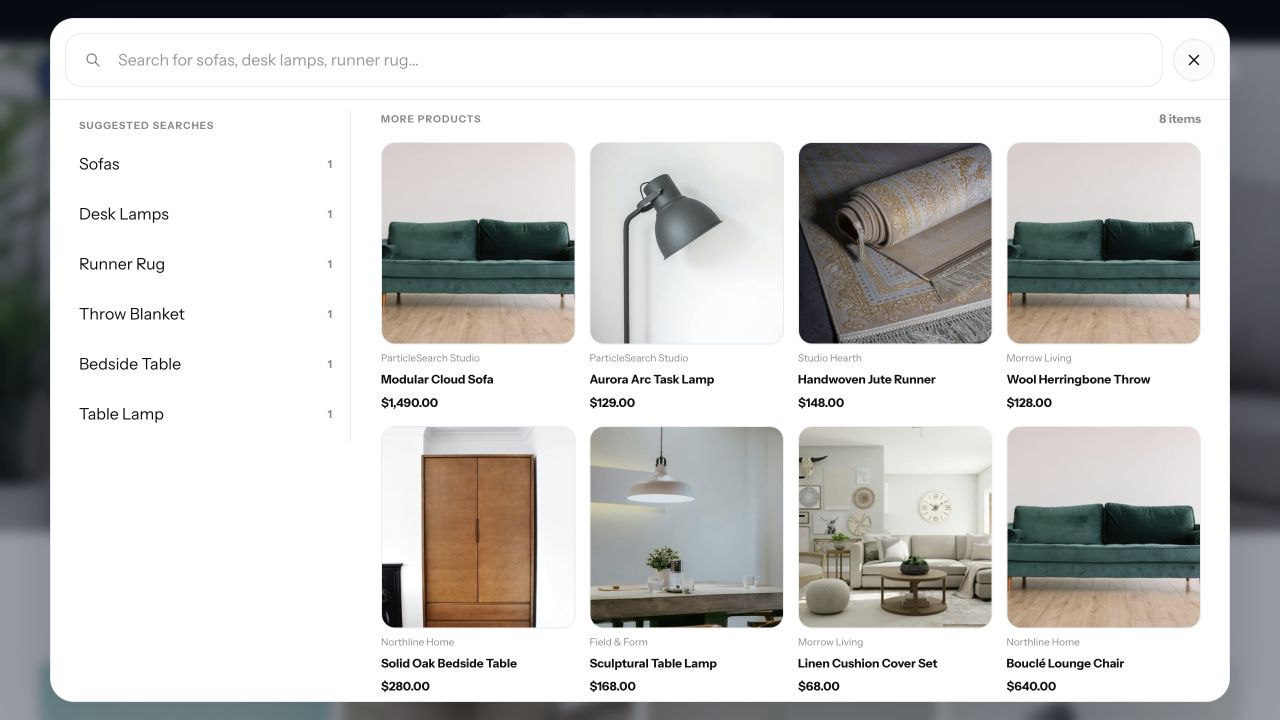
ParticleSearch
The product is there. Search says it isn't.
Why Shopify shoppers miss products you already sell, how search relevance affects product discovery, and how to test whether customers can find the right item.
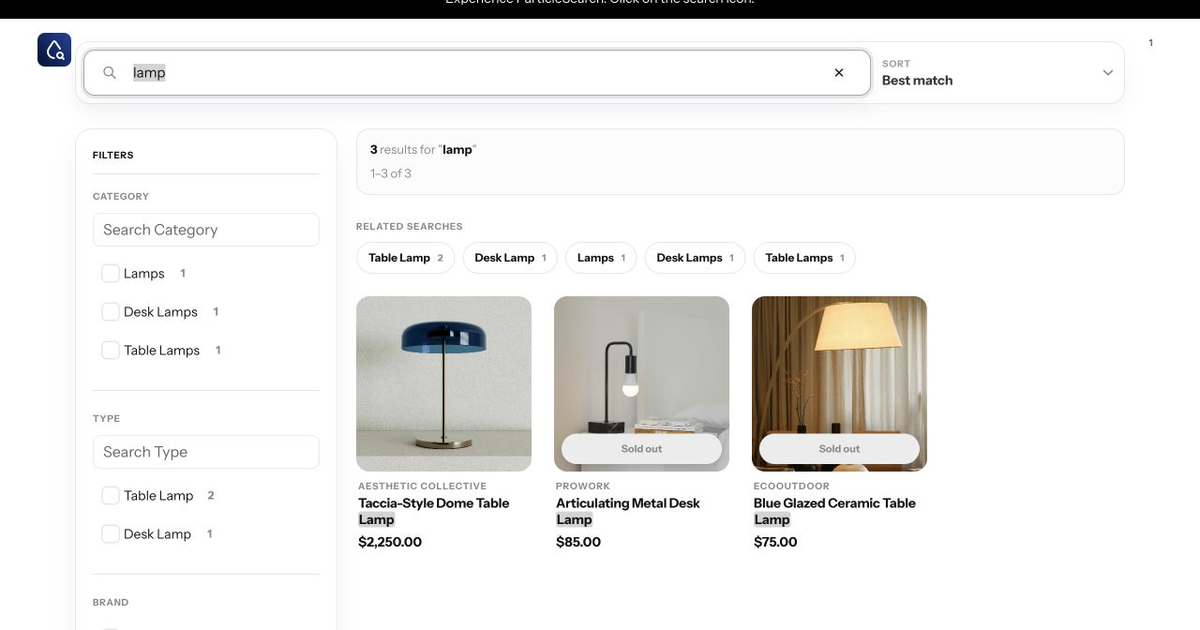
ParticleSearch
ParticleSearch Storefront Search: Modal, Results Page, Filters, and Product Handoff
Choose a ParticleSearch storefront layout, then evaluate adaptive response composition, modal states, match evidence, collection browsing, filters, full-page continuation, product handoff, and responsive behaviour.
ParticleSearch Guides
ParticleSearch Product Recommendations: Strategies, Placements, Controls, and Evidence
Understand ParticleSearch recommendation strategies, product and cart placements, theme and dashboard ownership, merchant controls, candidate safety, event states, experiments, attribution, and launch acceptance.
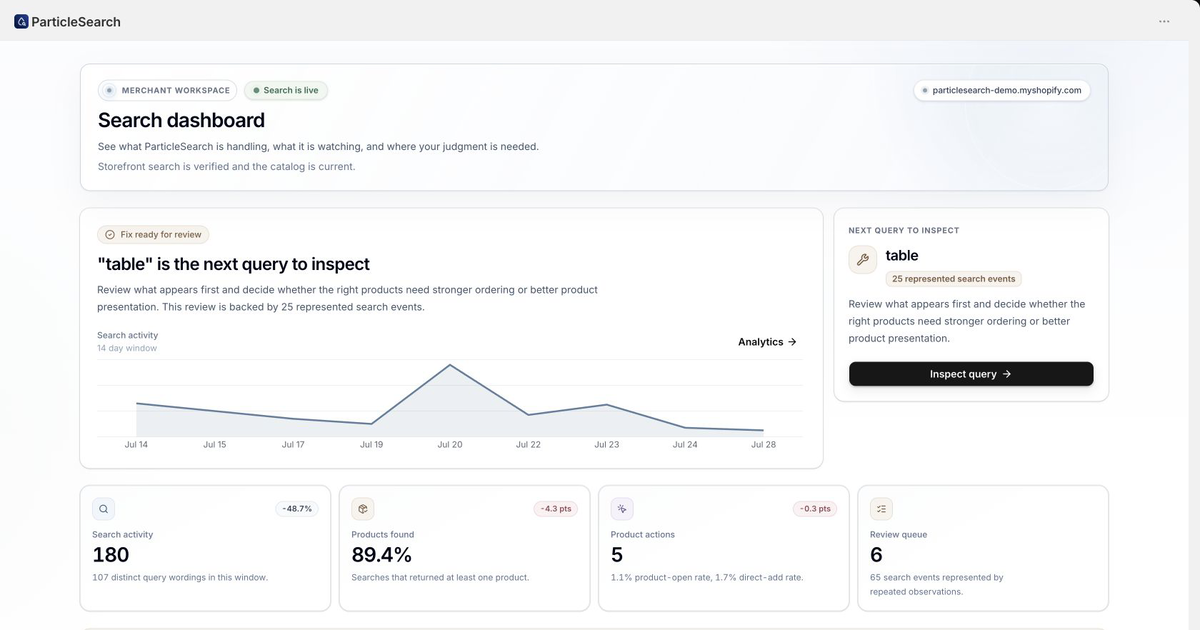
ParticleSearch
ParticleSearch Search Analytics: Turn Shopper Queries into a Review Queue
Understand committed shopper searches, request executions, products found, product actions, quality goals, Fixes, regression protection, deeper views, and attributed outcomes, then turn repeated evidence into one merchant decision.
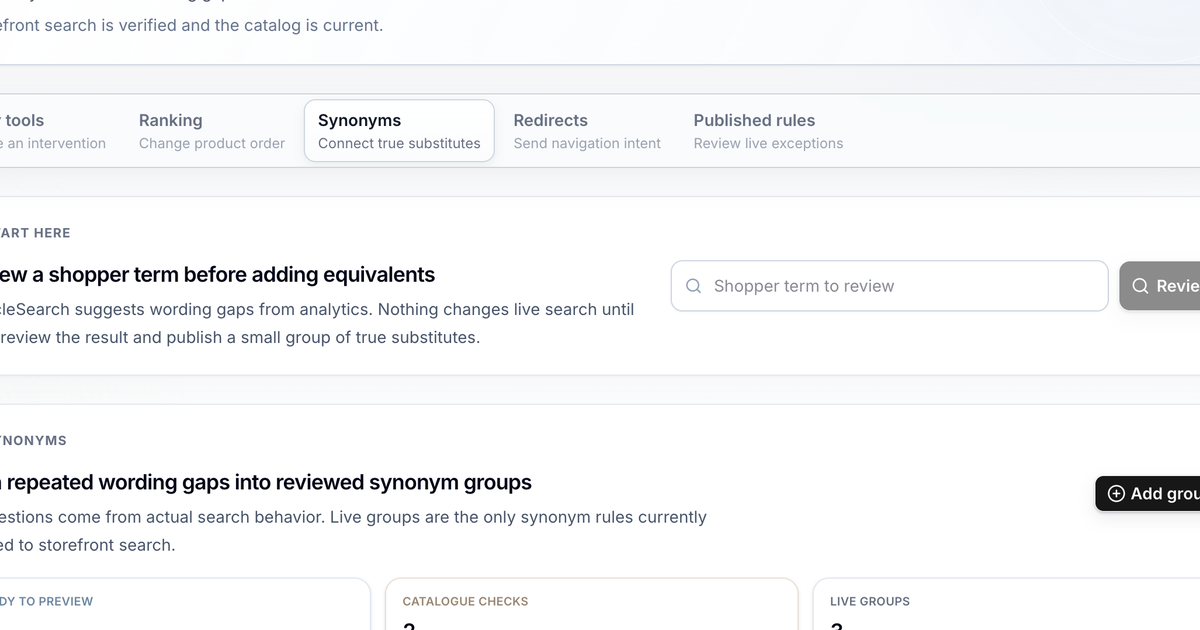
ParticleSearch
ParticleSearch Query Tools: Ranking, Synonyms, Redirects, and Safe Publishing
Learn why merchants change ranking, when two terms belong in a synonym group, when search should redirect, and how ParticleSearch separates live behavior, reviewed drafts, publishing, and follow-up.
ParticleSearch
How to Launch ParticleSearch on Shopify: Sync, Verify, and Go Live
Launch ParticleSearch with an evidence-backed sequence: confirm access, prepare the catalog, enable the published theme, run buyer-job acceptance queries, and establish the first operating review loop.
ParticleSearch
ParticleSearch Catalog Health: How to Know Shopify Search Is Ready to Trust
Understand ParticleSearch health domains, catalog visibility, indexed coverage, freshness, deployment states, webhook delivery, and the diagnostic path from a missing product to a trustworthy search test.
Complete learning programs
Learn a subject in order, then use it on a real store.
Each program moves from the mental model to diagnosis, implementation, operation, and evaluation. Every existing article remains available and has a defined place in the library.
Program 1 11 lessons Search foundations and relevance
Learn how query intent, lexical and semantic retrieval, ranking signals, fuzzy matching, predictive search, and synonyms work together.
Search foundations and relevance
Learn how query intent, lexical and semantic retrieval, ranking signals, fuzzy matching, predictive search, and synonyms work together.
What you will be able to do
You can explain why a result appeared, identify which relevance layer is weak, and choose a defensible intervention.
Step 1
Understand the system
Build the mental model and learn what each layer can and cannot change.
Step 3
Implement the right change
Configure or design the smallest intervention that addresses the proven problem.
- 1 Why Shopify Search Changes After Enter
- 2 How to Set Up Shopify Synonyms, and Prove They Work
- 3 Ecommerce Search Query Types: Exact, Category, Attribute, and Problem Queries
- 4 BM25 for Ecommerce Search: Formula, Field Scoring, Tuning, and Diagnosis
- 5 Fuzzy Search for Ecommerce: Typo Recovery, False Matches, and Safe Tuning
- 6 Lexical vs Semantic Search for Ecommerce: Retrieval, Hybrid Design, and Testing
- 7 Ecommerce Search Ranking Signals: Relevance, Business Rules, and Evaluation
Program 2 19 lessons Storefront search UX and conversion
Learn the complete shopper journey across entry points, autocomplete, results, cards, mobile, accessibility, recovery, and product choice.
Storefront search UX and conversion
Learn the complete shopper journey across entry points, autocomplete, results, cards, mobile, accessibility, recovery, and product choice.
What you will be able to do
You can audit a search experience end to end and improve conversion without optimizing a misleading local metric.
Step 1
Understand the system
Build the mental model and learn what each layer can and cannot change.
- 1 Ecommerce Search UX: The Complete Guide to Product Finding
- 2 Ecommerce Search Conversion: Why the Search Bar Is High-Intent Real Estate
- 3 When Ecommerce Search Deserves More Investment: An Operating Framework
- 4 The Cost of Bad Shopify Search: A Store-Specific Measurement Model
- 5 Shopify Product Listing Guide: Build a Searchable, Filterable Product Record
- 6 Ecommerce Product Discovery Optimization: Search, Browse, and Product Choice
- 7 Ecommerce Search Layout: How to Choose Inline, Popup, Modal, or Full-Page Search
Step 2
Diagnose the failure
Use observable evidence to find the first broken handoff before choosing a fix.
Step 3
Implement the right change
Configure or design the smallest intervention that addresses the proven problem.
- 1 Adaptive Ecommerce Search Journeys: Match the Response to the Shopper Job
- 2 Ecommerce Search Product-Card Match Evidence: Show Why a Result Belongs
- 3 Mobile Ecommerce Search: Modal, Filters, Product Cards, and Return Paths
- 4 Ecommerce Search Accessibility: Keyboard, Focus, Status, Filters, and Product Actions
- 5 Zero-Result Pages: How to Recover Search Without Misleading Shoppers
- 6 Ecommerce Typo Tolerance: What Shopify Corrects, and What It Does Not
- 7 Ecommerce Autocomplete UX: How Predictive Search Works in Online Stores
- 8 Ecommerce Search Results Page Design: States, Cards, Filters, and Measurement
- 9 Ecommerce Search Modal UX: When to Use It and How to Design It
- 10 Inline Ecommerce Search UX: Patterns, Layouts, States, and Handoffs
Step 5
Evaluate the decision
Compare alternatives and evidence without confusing attribution, activity, and causal lift.
Program 3 15 lessons Catalogue, variants, markets, and B2B truth
Learn how identity, taxonomy, attributes, variants, inventory, price, publication, markets, languages, and buyer context determine what search may return.
Catalogue, variants, markets, and B2B truth
Learn how identity, taxonomy, attributes, variants, inventory, price, publication, markets, languages, and buyer context determine what search may return.
What you will be able to do
You can separate a retrieval problem from a source-data or eligibility problem and preserve the purchasable item through the handoff.
Step 1
Understand the system
Build the mental model and learn what each layer can and cannot change.
Step 2
Diagnose the failure
Use observable evidence to find the first broken handoff before choosing a fix.
- 1 Shopify B2B Search Eligibility: Markets, Catalogues, Customer Context, and Price Truth
- 2 B2B Shopify Search: How to Diagnose and Fix Identifier Lookup for Wholesale Catalogs
- 3 Ecommerce Search Across Markets: Eligibility, Price, Stock, and Customer Context
- 4 Why Shopify Search Shows Wrong Prices or Stock: A Data-Path Diagnostic
Step 3
Implement the right change
Configure or design the smallest intervention that addresses the proven problem.
- 1 B2B Parts and Compatibility Search on Shopify: Fitment, Exact Identity, and Safe Handoff
- 2 Ecommerce Product Taxonomy for Search: Categories, Types, Collections, and Attributes
- 3 Ecommerce Variant Search: How SKUs, Options, Price, and Cart Handoff Stay Correct
- 4 Inventory-Aware Ecommerce Search: Sold-Out Visibility, Ordering, Variants, and Freshness
- 5 Ecommerce Product Data Normalisation: Canonical Values, Units, Aliases, and Migration
- 6 Multilingual Ecommerce Search: Locale, Synonyms, Attributes, and Query Recovery
- 7 Ecommerce Search Indexing: From Eligible Product to Rendered Result
Step 4
Launch and operate it
Publish safely, verify the live result, and keep the system healthy as the store changes.
Step 5
Evaluate the decision
Compare alternatives and evidence without confusing attribution, activity, and causal lift.
Program 4 5 lessons Filters, facets, and navigation
Learn how facet data, groups, values, counts, collection context, mobile interaction, and URLs form one navigation system.
Filters, facets, and navigation
Learn how facet data, groups, values, counts, collection context, mobile interaction, and URLs form one navigation system.
What you will be able to do
You can design filters that narrow truthfully, diagnose missing values, and keep browse and search context coherent.
Step 1
Understand the system
Build the mental model and learn what each layer can and cannot change.
Step 2
Diagnose the failure
Use observable evidence to find the first broken handoff before choosing a fix.
Step 3
Implement the right change
Configure or design the smallest intervention that addresses the proven problem.
Program 5 7 lessons Search merchandising and query control
Learn when to rank, pin, hide, redirect, schedule a campaign, or leave the relevance system alone.
Search merchandising and query control
Learn when to rank, pin, hide, redirect, schedule a campaign, or leave the relevance system alone.
What you will be able to do
You can publish a focused commercial intervention with a clear reason, preview, rollback path, and measurement plan.
Step 1
Understand the system
Build the mental model and learn what each layer can and cannot change.
- 1 Seasonal Search Merchandising: Campaign Scope, Inventory, Testing, and Retirement
- 2 Ecommerce Search Merchandising and Campaigns: Scope, Priority, Expiry, and Measurement
- 3 Search Merchandising for Shopify: Controls, Governance, and Safe Rollouts
- 4 Data-Driven Search Merchandising: From Query Evidence to Safe Ranking Changes
Step 3
Implement the right change
Configure or design the smallest intervention that addresses the proven problem.
Step 5
Evaluate the decision
Compare alternatives and evidence without confusing attribution, activity, and causal lift.
Program 6 10 lessons Analytics, experiments, and search operations
Learn the event chain, metric denominators, quality goals, repair queues, safe publishing, monitoring, QA, and controlled evaluation.
Analytics, experiments, and search operations
Learn the event chain, metric denominators, quality goals, repair queues, safe publishing, monitoring, QA, and controlled evaluation.
What you will be able to do
You can turn search evidence into an owned operating loop without overstating shopper visibility, revenue attribution, or lift.
Step 1
Understand the system
Build the mental model and learn what each layer can and cannot change.
- 1 Ecommerce Search Quality Goals: Choose a Metric Without Gaming Search
- 2 Ecommerce Search Operations: Health, Quality, Releases, and Ownership
- 3 Safe Ecommerce Search Publishing: Preview, Golden Queries, Runtime Checks, and Rollback
- 4 Shopify Search Analytics: Seven Metrics and the Decisions They Support
- 5 What Your Zero-Results Queries Are Telling You About Your Catalog
- 6 Which Search Queries Actually Produce Sales: Revenue Attribution for Shopify
- 7 Search Intent Mapping: Build Query Families, Expected Results, and Safe Repairs
- 8 Ecommerce Search Analytics: Events, Metrics, Diagnosis, and Experiments
Step 2
Diagnose the failure
Use observable evidence to find the first broken handoff before choosing a fix.
Step 5
Evaluate the decision
Compare alternatives and evidence without confusing attribution, activity, and causal lift.
Program 7 7 lessons Product recommendation systems
Learn recommendation jobs, candidate generation, eligibility, ranking, set quality, placement, diagnosis, analytics, attribution, and experiments.
Product recommendation systems
Learn recommendation jobs, candidate generation, eligibility, ranking, set quality, placement, diagnosis, analytics, attribution, and experiments.
What you will be able to do
You can design and evaluate a recommendation surface from shopper context to commercial outcome.
Step 1
Understand the system
Build the mental model and learn what each layer can and cannot change.
Step 2
Diagnose the failure
Use observable evidence to find the first broken handoff before choosing a fix.
Step 3
Implement the right change
Configure or design the smallest intervention that addresses the proven problem.
Program 8 17 lessons Shopify diagnosis, limits, and migration
Learn how to isolate missing products, wrong results, SKU gaps, theme conflicts, platform limits, and rollout risks before replacing search.
Shopify diagnosis, limits, and migration
Learn how to isolate missing products, wrong results, SKU gaps, theme conflicts, platform limits, and rollout risks before replacing search.
What you will be able to do
You can prove the failing Shopify layer, choose the smallest repair, and migrate only when the evidence supports it.
Step 1
Understand the system
Build the mental model and learn what each layer can and cannot change.
Step 2
Diagnose the failure
Use observable evidence to find the first broken handoff before choosing a fix.
- 1 Shopify SKU and Barcode Search Not Working?
- 2 Why Your Shopify Store Search Returns Zero Results: The Complete Fix Guide
- 3 Shopify's 5,000-Product Collection Filter Limit: Diagnosis and Options
- 4 Why Shopify Predictive Search Doesn't Show SKU Results (And How to Fix It)
- 5 Shopify Search Not Working? A Surface-by-Surface Diagnostic Guide
- 6 Products Not Showing in Shopify Search? The Product Eligibility Audit
- 7 Theme and App Conflicts That Break Shopify Search: An Isolation Guide
- 8 Did Shopify Semantic Search Break SKU or Barcode Lookup? Test the Claim
- 9 Why Shopify Search Shows Wrong Products: A Layer-by-Layer Diagnostic
Step 3
Implement the right change
Configure or design the smallest intervention that addresses the proven problem.
Step 4
Launch and operate it
Publish safely, verify the live result, and keep the system healthy as the store changes.
Program 9 4 lessons Choosing a Shopify search platform
Learn how to define requirements, compare apps, model total cost, run acceptance queries, and plan a responsible replacement.
Choosing a Shopify search platform
Learn how to define requirements, compare apps, model total cost, run acceptance queries, and plan a responsible replacement.
What you will be able to do
You can make a search investment decision from store needs and verified capability instead of feature-count marketing.
Step 1
Understand the system
Build the mental model and learn what each layer can and cannot change.
Step 5
Evaluate the decision
Compare alternatives and evidence without confusing attribution, activity, and causal lift.
Program 10 18 lessons Operating ParticleSearch
Learn the architecture, launch path, storefront, catalogue health, settings, query controls, analytics, recommendations, and experiments as one merchant workflow.
Operating ParticleSearch
Learn the architecture, launch path, storefront, catalogue health, settings, query controls, analytics, recommendations, and experiments as one merchant workflow.
What you will be able to do
You can configure ParticleSearch, verify what is live, interpret the evidence, and know where the product boundary ends.
Step 1
Understand the system
Build the mental model and learn what each layer can and cannot change.
Step 2
Diagnose the failure
Use observable evidence to find the first broken handoff before choosing a fix.
Step 3
Implement the right change
Configure or design the smallest intervention that addresses the proven problem.
- 1 ParticleSearch Ranking Rules: When to Pin, Boost, Move Lower, or Hide Products
- 2 ParticleSearch Search Campaigns: Audience, Market, Schedule, and Conflict Checks
- 3 ParticleSearch Storefront Search: Modal, Results Page, Filters, and Product Handoff
- 4 ParticleSearch Layout Settings: Choose an Experience, Then Fine-Tune the Surface
- 5 ParticleSearch Revenue Attribution: Direct, Assisted, and Verified Order Evidence
- 6 ParticleSearch Search Profiles: Choose the Right Starting Strategy for Your Catalog
- 7 ParticleSearch Golden Queries: Protect Important Searches Before You Publish
- 8 ParticleSearch Content Search: Help Shoppers Find Products, Pages, and Buying Guides
- 9 ParticleSearch Query Tools: Ranking, Synonyms, Redirects, and Safe Publishing
Step 4
Launch and operate it
Publish safely, verify the live result, and keep the system healthy as the store changes.
Step 5
Evaluate the decision
Compare alternatives and evidence without confusing attribution, activity, and causal lift.
Program 11 4 lessons Agent-ready ecommerce
Learn the catalogue, search-answer, authorization, and safe-action contracts a machine buyer needs.
Agent-ready ecommerce
Learn the catalogue, search-answer, authorization, and safe-action contracts a machine buyer needs.
What you will be able to do
You can distinguish agentic-commerce infrastructure from a conversational wrapper and design a bounded, auditable handoff.
Step 1
Understand the system
Build the mental model and learn what each layer can and cannot change.
Step 3
Implement the right change
Configure or design the smallest intervention that addresses the proven problem.
Pillar guides
Go deep when the decision is broad.
Search UX
Ecommerce Search UX: The Complete Guide to Product Finding
Design one coherent search journey across input, autocomplete, results, filters, mobile, accessibility, product cards, variant handoff, state recovery, and measurement.
Search Operations
Ecommerce Search Operations: Health, Quality, Releases, and Ownership
Operate search as a maintained service across store authority, catalogue delivery, storefront runtime, protected queries, measurement, incident triage, change control, and rollback.
Product Recommendations
Ecommerce Product Recommendations: Strategy, Systems, UX, and Measurement
Design product recommendations from shopper job to candidate generation, eligibility, ranking, placement, quality review, experiments, and operational governance.
Search Merchandising
Search Merchandising for Shopify: Controls, Governance, and Safe Rollouts
Learn what Shopify Search & Discovery can change natively, how to choose boosts, synonyms, custom ranking or redirects, and how to govern, test, measure, and retire rules.
Catalog Quality
Ecommerce Catalog Quality for Search: Fields, Variants, Taxonomy, and Freshness
Build search-ready product data with stable identity, category-specific attributes, variant precision, normalization, freshness, field contracts, and source-to-storefront ownership.
Search Relevance
Ecommerce Search Relevance: A Practical System for Better Results
Build an ecommerce relevance system with query families, graded judgments, pipeline diagnosis, ranked metrics, controlled tuning, and safe release checks.
Search Analytics
Ecommerce Search Analytics: Events, Metrics, Diagnosis, and Experiments
Connect ecommerce queries, responses, visible results, choices, variants, and purchases; map Shopify reporting boundaries; diagnose failures; and measure changes honestly.
Full library map
Every guide has a topic path.
The curated paths above are starting points. This map keeps the complete editorial library connected by subject, so a reader and a crawler can move from a broad question to the most specific explanation without relying on client-side search.